
OPEN PHILANTHROPY
Our Search for Answers on Place-Based Funding and How It's Shaping Our Grantmaking
By Natalia Valenzuela Swanson, Senior Director of Community Impact
One of the hardest questions in philanthropy is deciding when to invest in specific geographic areas and when to invest in community-wide solutions.
As the Mary Black Foundation sharpened its focus on children and families, we found ourselves grappling with that question. We first needed to understand where Spartanburg’s youngest children face the greatest economic challenges and whether geography should shape how we invest. So, we spent more than a year looking for answers. Instead of giving us a clear roadmap, what we found made us rethink the questions we were asking.
Research shows that where someone lives shapes their health, educational opportunities, and overall well-being. As a health legacy foundation committed to improving outcomes for Spartanburg County, we know place matters. But knowing that doesn’t automatically tell us how to use that information responsibly and effectively in our grantmaking.
In previous years, we used ZIP code-level data to help guide investments. As our work evolved, we wondered whether looking more closely at census tracts, rather than ZIP codes, would give us a clearer picture of where support was needed most.
What we did
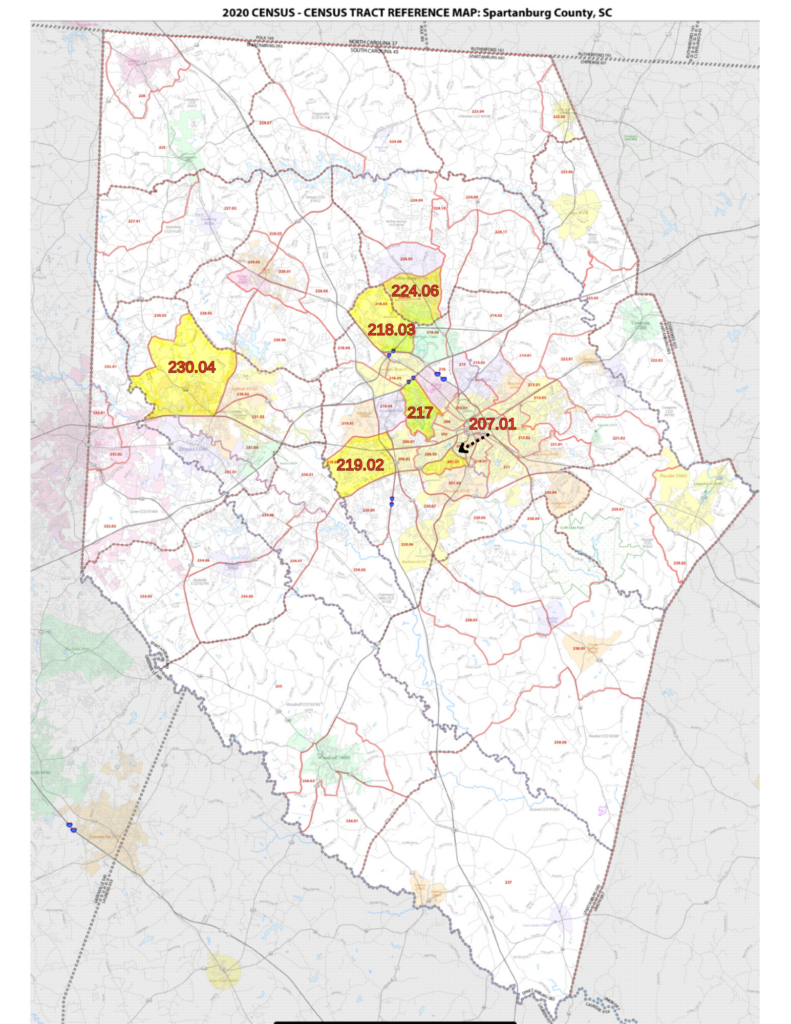
- With the help of a Wofford College professor, we started by identifying six census tracts in Spartanburg County with higher concentrations of young children living in economically challenged households using census and ALICE (Asset Limited, Income Constrained, Employed) data.
- We then looked at demographic trends within the communities, mapped assets, drove through neighborhoods with the help of Spartanburg County staff, and met with local leaders.
- Then, we spent time with elementary school principals of schools within the census tracts. They helped us understand what data couldn’t — what families are experiencing day-to-day. These conversations changed how we thought about the maps.
What we learned
1. Smaller maps don’t create clearer answers.
ZIP codes can hide important differences within a specific area, which is why we shifted to census tracts. But even census tracts contain very different communities within them. We learned that families within these communities are far from homogenous. Some of these communities had high numbers of single-led female households, others had racial and ethnic compositions that were different than those of Spartanburg County, and others had higher concentrations of foreign-born individuals. Geography can help us ask better questions, but it cannot make decisions for us.
2. There isn’t one picture of economic vulnerability.
Some families live in communities where financial hardship is highly visible and concentrated while others struggle in communities where their needs are much less visible. What that tells us is that one single strategy won’t reach every family. Place-based investments are important, but so are broader efforts to support families across Spartanburg County. Finding the right balance is key.
3. Listening matters as much as mapping data.
The data pointed us towards certain communities and the conversations we had with people living and working in those communities helped us understand them. School principals were able to describe challenges that a spreadsheet or map could never fully capture — from families moving several times during a school year to the consistent issue of housing instability and the effects it has on children. Without these conversations, we might have missed much of the context behind the numbers.
Why it matters
This work has already informed our grant process by helping our team make connections between the work proposed in grant applications and the needs that we see in our community. When organizations applying for funding describe the communities they serve, we now have a deeper understanding of the different realities that can exist, even within a few square miles.
As part of our team’s continuous learning, throughout the year, we revisit what we’ve learned and build on the knowledge we’ve gained to help shape the evolution of our funding strategies. More importantly, this project reminded us that good decisions require more than good data; they require curiosity and a willingness to question assumptions. This will continue to shape the evolution of our funding strategies.
We still don’t know exactly how this research will shape our work, and we don’t have an exact formula for deciding where to invest. What we do have is a better understanding of the complexity of our community. It has helped us ask better questions and given us a greater appreciation that maps should inform our decisions but not make decisions for us. We’ll keep learning, listening, and adjusting as we go. While that’s less tidy than having a definitive answer, it’s a more honest reflection of the work.

Natalia Valenzuela Swanson is the Senior Director of Community Impact at the Mary Black Foundation, where she oversees the Foundation’s grantmaking process and partnerships with nonprofit organizations. Since joining the Foundation in 2015, she has worked to foster collaboration and support for community-driven solutions that improve the health and well-being of Spartanburg residents.
Open Philanthropy is a recurring column in our monthly newsletter dedicated to pulling back the curtain on how we make funding decisions, why we structure things the way we do, and how we’re always working to be a better partner.
